Why an Ewa Beach Home Just Listed With an $18,000 Credit Instead of a Lower Price
Pedro Garcia October 1, 2026
Pedro Garcia October 1, 2026
Why would a seller in Ewa Beach knock $18,000 off the closing costs on a $914,000 home instead of just listing it at $896,000?
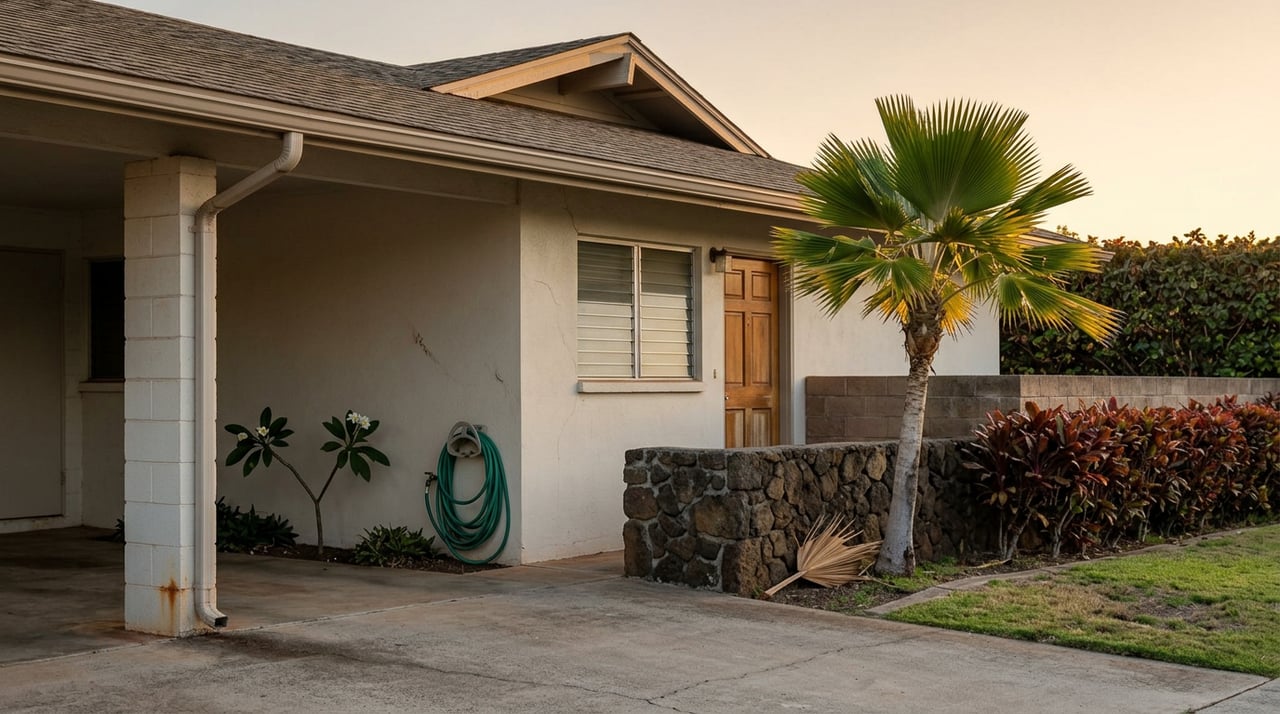
That's the exact question sitting on the MLS this month in Mamaka at Ho'opili, where a three-bedroom, two-and-a-half-bath home is listed at $914,000 with an advertised $18,000 sellers credit attached. The list price stays put. The discount moves to a different line item entirely. A few doors down, another unit in the same building is listed at $925,000 with no credit mentioned at all, just a description of its corner lot and condition. Same street. Same builder's brokerage arm handling both listings. Two different ways of getting to the same buyer's monthly payment.
This listing illustrates how an advertised credit can appear alongside a home's asking price, including in a market with new-home releases.
Ho'opili is D.R. Horton's roughly 1,500-acre master-planned community on the Ewa Plain, built out in phases with names like Uluwehi, Kāpili, Alana, Nanahea, and Ahakea, each releasing new inventory every few weeks as the project works toward its planned total of around 11,750 homes. Watch the pricing on a single neighborhood over time and a pattern shows up immediately.
Kāpili at Ho'opili Pōhaku Estates released its first homes in 2025 starting around $570,000 for a two-bedroom unit. By June 2026, the same neighborhood's latest release started at $659,945. The list prices climbed steadily, release over release. What didn't show up as clearly in that headline number was the financing attached to it. An October 2025 release of Kāpili townhomes advertised promotional interest rates as low as 4.99% through DHI Mortgage, the builder's in-house lender, plus up to $5,000 in closing cost credits.
Those incentives can affect a buyer's monthly payment in ways a price-per-square-foot comparison does not capture.
Buyers comparing a Ho'opili home to a resale elsewhere in Ewa Beach often price out the neighborhood-level HOA fee, which at Ho'opili runs roughly $200 to $500 a month depending on the specific community, and stop there. That's an incomplete comparison. Ho'opili also carries a separate master association fee that has been reported around $59 a month across the broader development, layered on top of whatever the individual neighborhood charges for its own pool, park, or clubhouse.
A resale home elsewhere in Ewa Beach, in an older subdivision like Ocean Pointe or one of the finished Ewa by Gentry neighborhoods, typically carries a single HOA line. A Ho'opili home carries two. The fees may appear separately in marketing materials, so buyers comparing listing sheets should check whether both are included in the monthly total.
Here's where the friction actually catches people off guard, particularly on VA financing, which is common in Ewa Beach given its proximity to Joint Base Pearl Harbor-Hickam.
VA guidelines cap seller concessions at 4 percent of the home's reasonable value. FHA is more generous, allowing interested party contributions up to 6 percent for costs like origination fees, prepaid items, and discount points. Both programs also count a builder-style temporary rate buydown as a seller concession, meaning it draws from the same capped pool as everything else the seller is willing to contribute.
Run the math on that Mamaka listing. Four percent of $914,000 is roughly $36,560. The $18,000 credit already on the table uses about half of that ceiling. If a buyer also wants a meaningful rate buydown stacked on top of the credit, on a VA loan, the room to do both starts to disappear fast, especially once ordinary closing costs and prepaid items are factored into the same 4 percent cap.
That's not a reason to avoid resale. It's a reason to have the concession math done before the offer goes in, not after the appraisal comes back and the numbers don't fit.
In most established Oahu neighborhoods, seller-concession adjustments are a minor line item because most nearby closed sales are ordinary resales without a credit attached.
Ho'opili is different. In a submarket where new construction with a builder credit and a promotional rate makes up a large share of what's closed recently, an appraiser working on a resale contract nearby may be pulling from a comp pool where several of the closest matches were sold with an incentive baked in. That means more adjustment work on the appraisal, not fewer eligible comps, but it's worth knowing going in rather than being surprised by an appraisal that needed extra explanation to land at the contract price.
None of this is happening in a soft market where sellers are desperate. Across Oahu, single-family homes sold in August 2026 spent a median of just 17 days on market, down from 22 days a year earlier, and sellers received a median of 100 percent of their original asking price, with a third of transactions closing above ask. The single-family median price rose 12.2 percent year over year in that same August 2026 reading. Condos told a different story, with the median dipping about 1 percent to $510,000 and days on market improving to 37 from 48 the year before.
That's a market where a resale seller with a well-priced single-family home in most Oahu neighborhoods has real leverage. The fact that a home inside Ho'opili is still reaching for a credit instead of leaning on that broader strength says something specific about this particular submarket: the competition isn't other resale sellers down the street, it's the builder's next phase release, which can appear within the same zip code every 30 to 60 days with its own rate and its own credit. Island-wide momentum doesn't cancel out block-by-block competition with an active builder.
If you're selling a resale home within Ho'opili or in one of the adjacent, already-built Ewa Beach neighborhoods, the useful move is finding out what incentive the builder is running that month before you decide whether your number is a price or a credit. If you're buying with VA or FHA financing, the useful move is running the concession cap against your actual closing costs and any rate buydown you're hoping for, before you're three weeks into a contract discovering there isn't room for both. If you're comparing HOA fees across a shortlist, ask whether the number you're looking at includes a master association fee layered underneath it.
None of this changes whether Ho'opili or an established Ewa Beach neighborhood is the better fit for a given household. It changes whether the price you're comparing is actually the price you're going to pay.
Does a builder's promotional rate buydown count against my VA loan's concession limit? Yes. VA guidance treats a temporary buydown offered by the builder or seller as a seller concession, and it draws from the same 4 percent cap as closing cost credits and other contributions.
Is the HOA fee on a Ho'opili listing the full monthly cost? Not necessarily. Many Ho'opili neighborhoods carry a separate master association fee on top of the neighborhood-specific HOA, so it's worth asking for both figures rather than assuming one line covers everything.
If you're weighing a resale home against new construction anywhere on the Ewa Plain, or trying to figure out what a seller credit actually means for your monthly payment on a VA or FHA loan, Hawai'i Homefront can walk through the concession math with you before you write the offer, not after.
This article is general information, not legal, tax or financial advice. Consult a qualified professional about your situation.
Stay up to date on the latest real estate trends.
The Hawai’i Homefront provides expert real estate guidance across Honolulu, helping buyers and sellers navigate the market with confidence, clarity, and local insight.
HAWAI'I HOMEFRONT
4211 Waialae Ave Ste 100 Honolulu, HI 96816