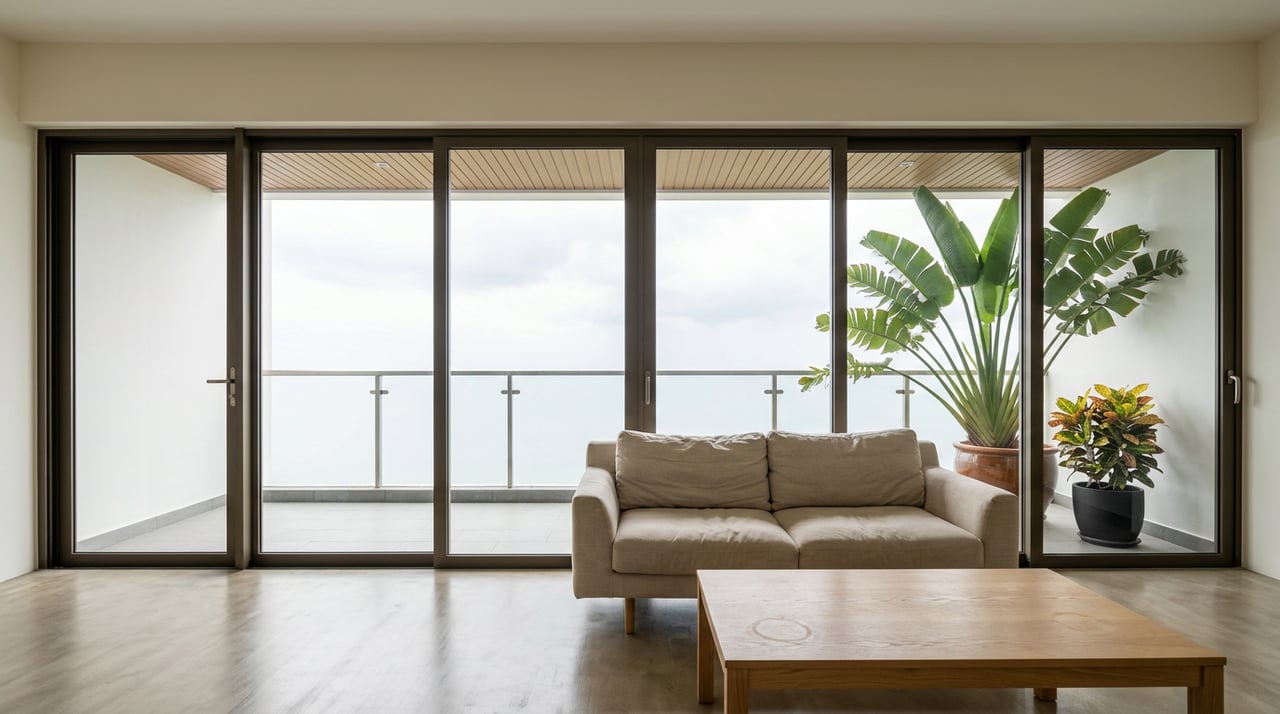
Honolulu Condo Special Assessments, Insurance and Financing
Pedro Garcia September 24, 2026
Pedro Garcia September 24, 2026
Two units. Same building age, same square footage, same view of the H-1 and a sliver of ocean past the next tower. One buyer gets a conventional loan approved in three weeks. The other gets a call from their lender two weeks before closing: the building can't be financed conventionally right now, and unless they can pay cash, the deal is dead.
Nothing changed about either buyer's credit, income, or down payment. What changed was a number in the association's insurance binder.
That number is the percentage of the building's hurricane exposure the master policy actually covers. In some Honolulu condo towers, that percentage can affect conventional financing.
Fannie Mae and Freddie Mac won't purchase a mortgage on a condo unit unless the building's master policy covers the building at full replacement value for hurricane risk. That rule exists because those two entities buy roughly 70 percent of mortgages from primary lenders, so if a building can't clear that bar, most lenders simply won't originate the loan for a unit inside it. Buyers are left with cash or a narrow slice of portfolio lenders, and the pool of people who can bid on that unit shrinks accordingly.
Here's the part that catches people off guard: Hawaii's admitted insurance market, the licensed carriers the state can actually regulate, often covers only 20 to 30 percent of a building's hurricane exposure. The Department of Commerce and Consumer Affairs has been direct about this in its own condo insurance guidance: associations are forced into the surplus lines market to close the rest of that gap, and surplus lines carriers aren't licensed in Hawaii, which means the state's insurance commissioner has no authority to cap what they charge.
So the gap between "insured" and "financeable" isn't a rounding error. Buyers should verify the building's coverage percentage early in the process.
"A silent crisis that's pushing thousands of residents to the brink."
That's how state senator Jarrett Keohokalole described the broader property insurance situation to lawmakers earlier this year, as reported by Agency Hawaii. For condo owners, the silence is the problem: coverage percentage doesn't show up on a listing sheet, and it rarely comes up until an appraisal or a lender's underwriter goes looking for it.
One factor behind these insurance costs is reinsurance, the insurance that insurance companies buy to cover their own catastrophic losses. Before the August 2023 Lahaina wildfire, Hawaii property insurers were paying reinsurers roughly 8 to 9 cents per $100 of insured value for hurricane risk. In the aftermath, that cost spiked past $1 per $100 for some buildings, an increase that flows straight through to AOAO premiums and, from there, straight into monthly maintenance fees and special assessments.
By this spring, state officials briefing lawmakers said rates had moderated into the 20 to 30 cent range, still two to three times pre-2023 levels but no longer in free fall upward. It's not hard to find real examples of what the peak years did to individual buildings. One Honolulu condo owner interviewed by KHON2 in 2024 described a $2,700 special assessment landing on top of a $600 monthly maintenance fee, itself stacked on an earlier $900 plumbing assessment the same year. Multiply that kind of notice across a 200-unit building and the scale of the disruption becomes clear.
Insurance cost benchmark | Pre-2023 | Peak (2023-2024) | Current (as of April 2026) |
|---|---|---|---|
Reinsurance cost per $100 of insured value | ~8-9 cents | $1+ | 20-30 cents |
Typical AOAO hurricane premium example (per building) | — | as high as $270,000/year | moderating, case by case |
Act 296, signed into law in 2025, reactivated the Hawaii Hurricane Relief Fund and expanded the Hawaii Property Insurance Association's authority to write coverage when the private market won't. The fund isn't a subsidy program. It provides excess hurricane coverage for AOAOs that have already been turned down by at least two licensed insurers, and only for losses above $10 million, so buildings still have to secure primary coverage on their own first.
The results so far are real but partial. Through early April 2026, the fund had received 311 applications and issued 97 policies covering roughly $2.6 billion in insured value, and officials told lawmakers the program had contributed to more than $12 million in savings statewide, split between policies written directly through the fund and private-market reductions negotiated using HHRF quotes as leverage. Act 296 also created a Condominium Loan Program to help associations finance repairs that improve insurability, though that fund isn't expected to actually issue loans for at least another year or two given the contracting and permitting timeline involved.
None of this changes the underlying math for a building that still can't reach full hurricane coverage today. It changes the odds that the building gets there eventually.
Coverage gaps and old infrastructure feed each other. A meaningful share of Honolulu's condo stock, concentrated in towers around Waikiki, McCully-Moʻiliʻili, and Makiki, was built in the 1960s and 1970s and has never had a major plumbing, electrical, or structural rehab. Corroded pipes are one of the most common triggers for special assessments statewide, according to the state's own consumer guidance on the subject, and water damage from aging plumbing is consistently cited as the largest driver of condo insurance claims in Hawaii.
Insurers know this, which means buildings that have proactively addressed plumbing and structural deferred maintenance tend to get better terms, not just lower premiums but a better shot at that 100 percent hurricane coverage threshold that keeps a building financeable.
There's a longer-term wrinkle worth knowing about even if it won't affect most transactions this year. Hawaii currently has no legal mechanism allowing a majority of owners in an aging, functionally obsolete building to force a collective sale for redevelopment, something several other states already allow. For a fifty-year-old tower facing repeated six-figure assessments with no redevelopment path, that's not an abstract policy debate. It shapes what the building's future actually looks like, which is part of what a buyer is really pricing in when they look at a unit that seems cheap for its square footage.
If you're buying:
If you're selling:
New FEMA flood maps for Oahu took effect this spring, which means some buildings that weren't previously in a mapped flood zone now are. If you haven't checked whether that applies to your building, it's worth a call to your property manager before you list or make an offer.
Does this only affect condos, or single-family homes too? Insurance costs have affected condo master policies most because of how concentrated the hurricane exposure is in one large structure, but individual homeowners on Oʻahu have also seen premium increases, and the new flood map designations apply island-wide, not just to condo buildings.
What's the difference between the AOAO's policy and my own coverage? Island Insurance explains that the AOAO's master policy covers the building structure and common areas. Your individual HO-6 policy covers your unit's interior, your belongings, and importantly, loss assessment coverage, which pays your share if a covered claim exceeds what the master policy pays out. It's a separate, relatively inexpensive add-on worth confirming you actually have.
Will this keep getting worse? State officials describe the market as stabilizing, not fixed. Reinsurance costs have come down from their peak, and the HHRF is showing measurable results, but the underlying age of much of Honolulu's condo inventory means this will stay relevant for years, not months.
None of this is a reason to avoid buying or selling a Honolulu condo. It's a reason to ask the right questions before you're three weeks from closing and hearing about a coverage gap for the first time. If you're weighing a purchase, preparing to list, or managing a sale from off-island and want someone who reads the AOAO paperwork as carefully as the listing photos, Hawaiʻi Homefront is a good place to start that conversation. Get a free home valuation and we'll walk through exactly what your building's insurance picture means for your timeline.
This article is general information, not legal, tax or financial advice. Consult a qualified professional about your situation.
Stay up to date on the latest real estate trends.
The Hawai’i Homefront provides expert real estate guidance across Honolulu, helping buyers and sellers navigate the market with confidence, clarity, and local insight.
HAWAI'I HOMEFRONT
4211 Waialae Ave Ste 100 Honolulu, HI 96816