What the Wahiawā–Mililani Price Gap Actually Buys: A Recorded Rule From 1968
Pedro Garcia October 15, 2026
Pedro Garcia October 15, 2026
"No more than one residence shall be constructed on any lot."
That sentence sits in the Mililani Town Declaration of Covenants, Conditions and Restrictions. The declaration was filed with the Land Court on April 19, 1968, as Document No. 441561. The same clause lets a guest suite count as part of the single residence, but only if it has no kitchen, is visually attached to the main house, and is joined to it by at least a covered walk or a wall or fence no less than six feet high. A buyer who closes on a home covered by the Mililani Town Association takes that restriction along with the keys, because it is part of the property's recorded documents.
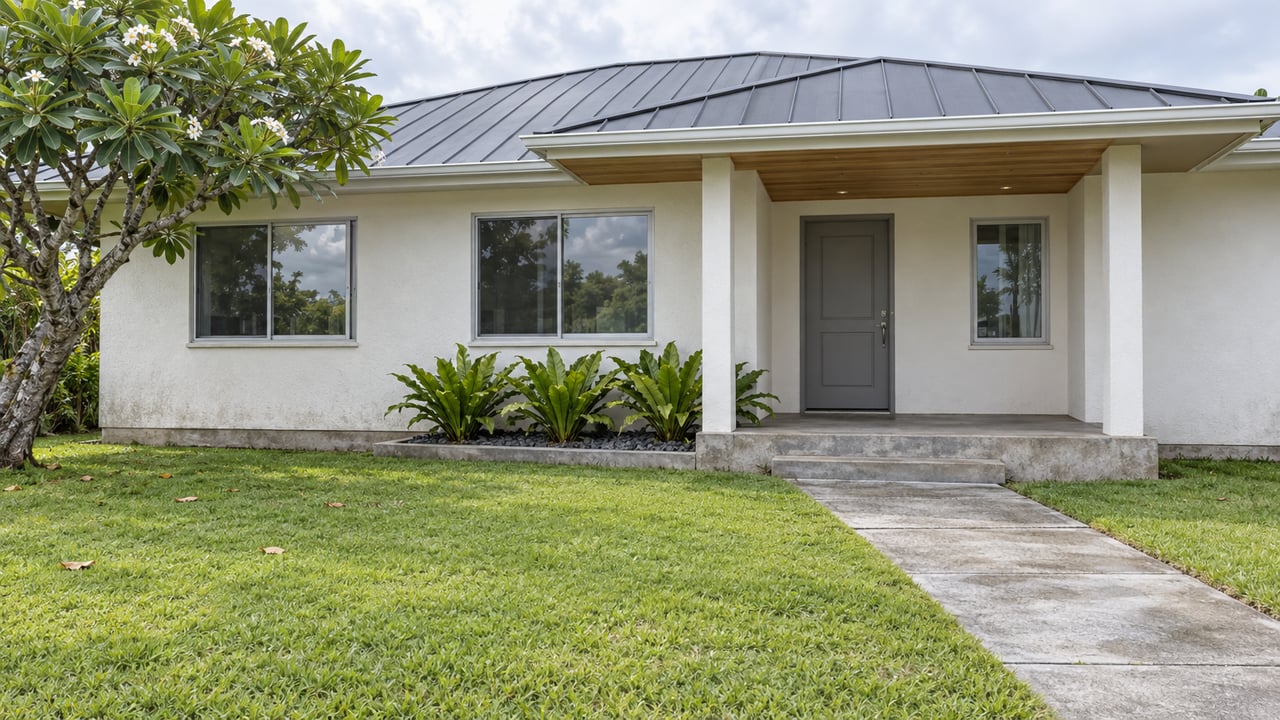
A few miles north, Wahiawā single-family homes have sold well below Mililani's all year. Portals show that gap as a single number. That number compares two different sets of rights. In much of Mililani, you pay more for a lot that is legally limited to one home, plus a recreation association. In Wahiawā, you pay less for a lot that may qualify for a second dwelling under Honolulu's code, as long as no recorded covenant on that parcel says otherwise. Using that option takes time, money and patience with the permit office.
Hawaiʻi's legislature took on accessory dwelling units directly in 2024. Act 39, approved May 28, 2024, requires counties to allow at least two ADUs, or a reasonable equivalent, on residentially zoned lots in the urban district. The act also limits private covenants. It says no covenant on such a lot "recorded after the effective date of this Act" may cap the number of ADUs below what the county allows or restrict long-term rentals. It then adds, "This section shall not apply to any private covenants recorded before the effective date of this Act."
Mililani's declaration dates to 1968, so the state law does not override its one-residence clause. The association's rules page still links the Declaration and the Design Committee Rules, along with a Mililani Town Rules document revised January 22, 2026. No public source turned up an amendment dealing with ADUs. Back in 2022, Hawaii Business Magazine reported that the association covers about 15,800 single-family homes and townhouses. It also reported that covenants like this one are why ADUs are common in Honolulu, Pearl City and Waipahu but not in Mililani.
When no covenant blocks it, Honolulu's zoning code decides. The Land Use Ordinance was revised in September 2025 after Ordinance 25-2. Section 21-5.50-3 sets these terms:
The code also requires a covenant for long-term residential occupancy, and it bars using an ADU as a bed-and-breakfast or transient vacation unit. According to the Department of Planning and Permitting, most Ordinance 25-2 changes took effect September 30, 2025. The department's own FAQ page has not caught up. It still lists the older 400 and 800 square-foot caps and an owner-occupancy condition that the revised ordinance text does not include. A buyer counting on a specific unit size needs written confirmation from DPP, not the FAQ.
In August 2025, Civil Beat described residential neighborhoods like Wahiawā as "prime territory" for ADUs. No public source confirms that every Wahiawā parcel is free of restrictive covenants. Whether a lot qualifies comes down to that parcel's recorded documents, zoning and infrastructure.
The Honolulu Board of REALTORS® tracks Wahiawā as TMK zones 1-7-1 through 1-7-7, using HiCentral MLS data. Its August 2026 report sets the two areas side by side:
Metric | Wahiawā | Mililani |
|---|---|---|
Single-family median, August 2026 | $908,000 on 2 sales | $1,290,000 on 19 sales |
Single-family median, year-to-date through August 2026 | $858,000 on 38 sales | $1,125,000 on 124 sales |
Median days on market, YTD through August 2026 | 14 | 10 |
Condo median, August 2026 | $415,000 on 5 sales | $515,000 on 18 sales |
The year-to-date figures give the steadier comparison. Through August 2026, the single-family gap was about $267,000. The August-only figure of $908,000 rests on two closings, and July 2026 rested on four, so Wahiawā's monthly median can swing a long way on one sale.
Wahiawā's supply tells its own story. Year-to-date through August 2026, the area had 46 new single-family listings, down from 73 in the same period of 2025. Closed sales fell from 44 to 38, and median days on market dropped from 41 to 14. Fewer homes are coming up, and the ones that do sell faster than they did a year ago.
On the Mililani side, the higher price includes a recurring cost. The association's assessment page lists $165 per quarter, effective April 1, 2025, billed in January, April, July and October. That comes to $660 a year. The association's February 2025 notice says the assessment pays for pools, courts, a gym, tot-lots, 220 acres of roadway landscaping, staff, and reserves for aging facilities. The obligation applies to each MTA homeowner under the declaration. Having a Mililani mailing address does not by itself prove a property is covered.
The two areas also come from different eras. Castle & Cooke started residential sales in Mililani in 1968, the same year the covenant was recorded, and began building Mililani Mauka in 1990. Wahiawā grew up decades earlier around pineapple, with cannery operations starting in 1903. None of the sources measure how much of the price gap comes from covenants, amenities, home age or location. They do show that a Mililani dollar and a Wahiawā dollar are buying different sets of rights.
The Wahiawā side of the comparison has a cost of its own, measured in time. Civil Beat reported that getting a permit and finishing construction for a rental unit in Wahiawā took more than four years. The same article listed the usual obstacles: limited sewer capacity, small yards, a slow permitting system, and construction costs. It also reported that a 2014 city plan expected at least 250 ADUs a year, while DPP counted 1,320 built since then. In an interview quoted in the article, DPP Director Dawn Takeuchi Apuna called it "Not really a super successful program."
The policy is still unsettled. Act 39 gives counties until December 31, 2026, about 11 weeks from now. If a county has not adopted or amended its zoning by then, the act's fallback applies to the owner of a single-family dwelling on a residentially zoned lot, or the owner's designated representative. When that owner applies for up to two ADUs, the county cannot deny the permit for exceeding the maximum number of housing units, and the fallback lasts until the county adopts or amends an ordinance. The county can still deny on infrastructure, design or development standards. On October 1, 2025, the Honolulu City Council adopted Resolution 25-271. It supports a proposal for the 2026 county legislative package that seeks repeal of the state's county ADU requirements. At the state level, HB 516 proposed repealing the two-ADU section. It was carried over to the 2026 session on December 8, 2025, and the official tracker shows no act. No DPP statement says whether the city considers its one-ADU-plus-ʻohana framework a reasonable equivalent.
Public investment around Wahiawā is moving on a separate track:
None of these sources tie the projects to home prices, so treat them as context, not a forecast.
Does Act 39 let a Mililani owner build an ADU despite the covenant? Not by itself. The act's covenant section expressly excludes covenants recorded before it took effect in 2024, and Mililani's declaration was recorded in 1968.
Is the August 2026 Wahiawā median a reliable value for a home? It reflects two sales. The year-to-date median of $858,000 across 38 sales through August 2026 is a broader read, and individual homes still vary widely.
Will Honolulu allow two ADUs after December 31, 2026? That is unresolved. The state deadline stands, the City Council has backed a repeal request, and HB 516 had not become law according to the official tracker.
If you're weighing a Wahiawā lot against a Mililani home and want to know what the recorded documents allow before you write an offer, Hawai‘i Homefront can pull the covenants, compare recent sales, and walk you through both sets of rights. If you already own in either area, start with a free home valuation built from those same records.
This article is general information, not legal, tax or financial advice. Consult a qualified professional about your situation.
Stay up to date on the latest real estate trends.
The Hawai’i Homefront provides expert real estate guidance across Honolulu, helping buyers and sellers navigate the market with confidence, clarity, and local insight.

HAWAI'I HOMEFRONT
4211 Waialae Ave Ste 100 Honolulu, HI 96816