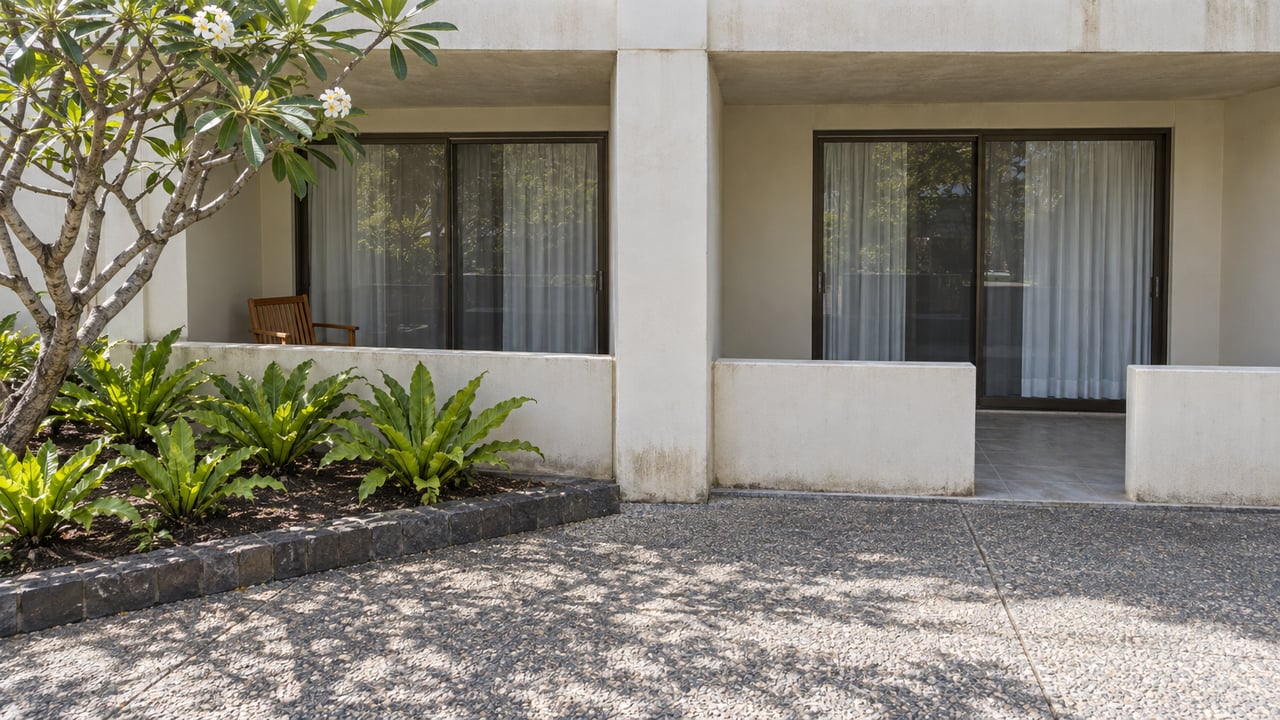
Skyline Runs Through Pearl City. So Why Did Condos Near the Stations Get Cheaper?
Pedro Garcia October 8, 2026
Pedro Garcia October 8, 2026
Since October 16, 2025, when Skyline's second segment opened, a rider can board at Kalauao (Pearlridge) Station and ride to Kalihi without touching H-1. For a 1970s tower in the Pearlridge area, the cheapest number in the listing is the price. The most expensive is the monthly maintenance fee, and in Pearl City and Aiea the fee is what buyers are pricing.
Locations' August 2026 neighborhood report covers the 12 months through August. Over that window the median Pearl City–Aiea condo sold for $420,000, down 9%. Active listings fell 24% over the same period, and months of remaining inventory fell 25% to 4.8. Prices fell while there were fewer units to choose from. Shrinking supply usually pushes prices up. When it doesn't, buyers are usually discounting something about what they're buying.
Pearl City–Aiea, 12 months through August 2026 | Single-family homes | Condos |
|---|---|---|
Median price | $1,145,000, up 9% | $420,000, down 9% |
Sales | 222, up 6% | 263, up 2% |
Median days on market | 13 | 42, up 20% |
Share sold above asking | 37.8% | 17.5% |
Months of remaining inventory | 1.6 | 4.8 |
Houses and condos share the same freeway exits, the same shopping and the same three rail stations. Over the same 12 months, the houses got bid up and the condos got cheaper. Across Oʻahu, the Honolulu Board of Realtors reported August 2026 medians of $1,240,000 for single-family homes and $510,000 for condos. So Pearl City–Aiea condos sit well below the island condo median even with Skyline running past them.
These figures combine Pearl City with Aiea and aren't broken out by distance to a station. No reporting we found ties the decline to rail or to any single cause. What the sources do show are three forces working at once, and each one explains part of the gap.
Skyline has served Pearl City since June 30, 2023, at Waiawa (Pearl Highlands), Kalauao (Pearlridge) and Hālawa (Aloha Stadium) stations. Today the line ends at Kahauiki (Kalihi Transit Center). The leg to Kaʻākaukukui (Civic Center) is under construction. HART expects guideway and station work to finish in 2030 and passenger service to begin in 2031.
That timeline may slip. In July 2026, Honolulu Civil Beat reported that a Federal Transit Administration consultant gave about a 65% chance that the Middle Street–Kakaʻako segment opens in spring 2032. HART said its official schedule had not changed and that it was still targeting March 31, 2031.
People are riding. The City counted 314,353 rides in August 2026, with an average of 12,530 on typical weekdays and a high of 14,143 on August 26. Those are systemwide totals, with no station-by-station count for Pearl City. A buyer pays for a station by what it connects to. For now it connects to the airport and Kalihi, while downtown and Kakaʻako are still at least five years away. A buyer looking at a Pearlridge-area condo today can't count on that future connection yet.
The second force is that nothing new has been built around the Pearl City stations. The City rezoned the Aiea-Pearl City station areas in October 2022 under Ordinances 22-29 and 22-30. The rezoning replaced single-use zoning with mixed-use zoning and lets developers build taller and denser in exchange for community benefits.
The City's plan for Kalauao (Pearlridge) imagines a Pearlridge Center that faces outward onto the street. It shows new streets through the mall parking lot and the former Kamehameha Drive-In site, with dense housing on the drive-in site. The City presents these ideas as plan proposals. At Waiawa (Pearl Highlands), the plan calls for a bridge from the station to the mall and structured parking in place of surface lots. HART's 2022 Recovery Plan moved the Pearl Highlands parking garage out of the funded scope and into a future phase. The City's TOD development-project tracker, updated September 10, 2026, lists no current application in the Pearl City or Aiea station areas.
The one completed project is at Hālawa. Hawaii News Now reported that Naulu Apartments, a $168 million, 25-story building from Pacific Development Group, opened in 2025 with 302 rental units for households earning 30% to 60% of area median income. Reported rents with utilities ran from $704 to $2,404, and the units must stay affordable for at least 61 years. Next door, the old Aloha Stadium was being dismantled as of August 2026. Groundbreaking for the new stadium was targeted for November 2026 to January 2027, with an opening targeted for spring 2029. The full district plan calls for 4,500 homes, built in phases over 20 to 30 years.
So the station areas have zoning in place and one finished affordable rental building. The retail, sidewalks and new housing that usually make station-area condos worth more haven't arrived.
The third force is the buildings themselves, and they have specific build years. Honolulu Fire Department's high-rise roster, dated April 24, 2026, lists these Pearlridge-area towers under Aiea:
The roster shows each of these buildings has submitted its life-safety evaluation, or LSE. It doesn't say what any building scored, what work is required, or what that work will cost. Under the Honolulu Fire Code adopted after the 2017 Marco Polo fire, building owners must meet with unit owners or tenants by May 3, 2030, to discuss a design plan, financing options and implementation timelines. By that same date they must file a statement of their design plan, timeline and intent to comply for approval. Buildings that choose to install sprinklers must also file a financial and design plan by May 3, 2030. Each building must be protected by sprinklers or approved alternatives by May 3, 2038. Not every building will need full sprinklers. Every building will need a plan, though, and a buyer who closes today will own the unit when that plan gets paid for.
That's where the fees come in. Hawaii Business reported in June 2026 that the average Oʻahu maintenance fee was $1,051 in February, based on Honolulu Board of Realtors data. The same article said fees have risen 70% over the past decade. In older buildings, the magazine pointed to failing cast-iron drain pipes, concrete spalling, elevator upgrades, roofs and fire sprinklers as the main costs. Honolulu Board of Realtors President Aaron Tangonan told the magazine that, at current mortgage rates, a $600 monthly fee is the difference between buying a $400,000 condo and a $500,000 condo.
Read that against the table above. The difference between those two price points is roughly the gap between the Pearl City–Aiea condo median and the island condo median. The neighborhood areas the magazine named for the sharpest fee increases were ʻEwa Gentry, Mililani, Salt Lake and Hawaiʻi Kai, not Pearl City. Still, the mechanism works the same way in any 1970s tower. A buyer has a monthly budget, and every dollar of fee comes out of the price that buyer can afford to pay.
Hawaii has added tools for condo associations, but each comes with eligibility limits. Act 296, signed July 7, 2025, revived the Hawaii Hurricane Relief Fund and created a condo repair-loan program. The relief fund is accepting association applications. The Hawaii Insurance Division says the relief fund only sells hurricane coverage above the first $10 million, and an association needs denials from at least two insurers licensed in Hawaii to qualify. By early March 2026 it had written 98 policies covering $2.38 billion in insured value.
The loan program is supposed to finance fire-safety work and pipe and roof repairs. The governor's office announced its launch on May 11, 2026. As of early October, the state's program page says the program is "on hold." An association counting on that loan may need another way to pay.
The answers belong in the comparison next to the asking price. A low price paired with an unplanned retrofit can cost more each month than a higher price in a building that has already done the work.
Will Pearl City condos gain value when rail reaches Civic Center? No source we found measures a rail premium in Pearl City. Service downtown is targeted for 2031, and a federal consultant's risk estimate points to spring 2032.
Do all of these towers need fire sprinklers? Not necessarily. The fire code allows compliance through an acceptable evaluation or approved alternatives. Every covered building still has to file a statement of its plan and intent to comply by May 3, 2030.
Is the house market in Pearl City softening too? No. Over the 12 months through August 2026, the Pearl City–Aiea single-family median rose 9%, and 37.8% of homes sold above asking.
If you're weighing a condo near Kalauao or Waiawa station, Pedro Garcia and the Hawai‘i Homefront team can help you request a building's fee history, LSE status and insurance details before you make an offer. If you already own in one of these towers, we can show you how buyers are pricing those same documents today.
This article is general information, not legal, tax or financial advice. Consult a qualified professional about your situation.
Stay up to date on the latest real estate trends.
The Hawai’i Homefront provides expert real estate guidance across Honolulu, helping buyers and sellers navigate the market with confidence, clarity, and local insight.
HAWAI'I HOMEFRONT
4211 Waialae Ave Ste 100 Honolulu, HI 96816